Nothing is classically spookier than claiming something is dead when it isn’t actually. See Edgar Allan Poe’s The Premature Burial for a sense of just how clearly haunting — and seasonally appropriate! — this concept is.
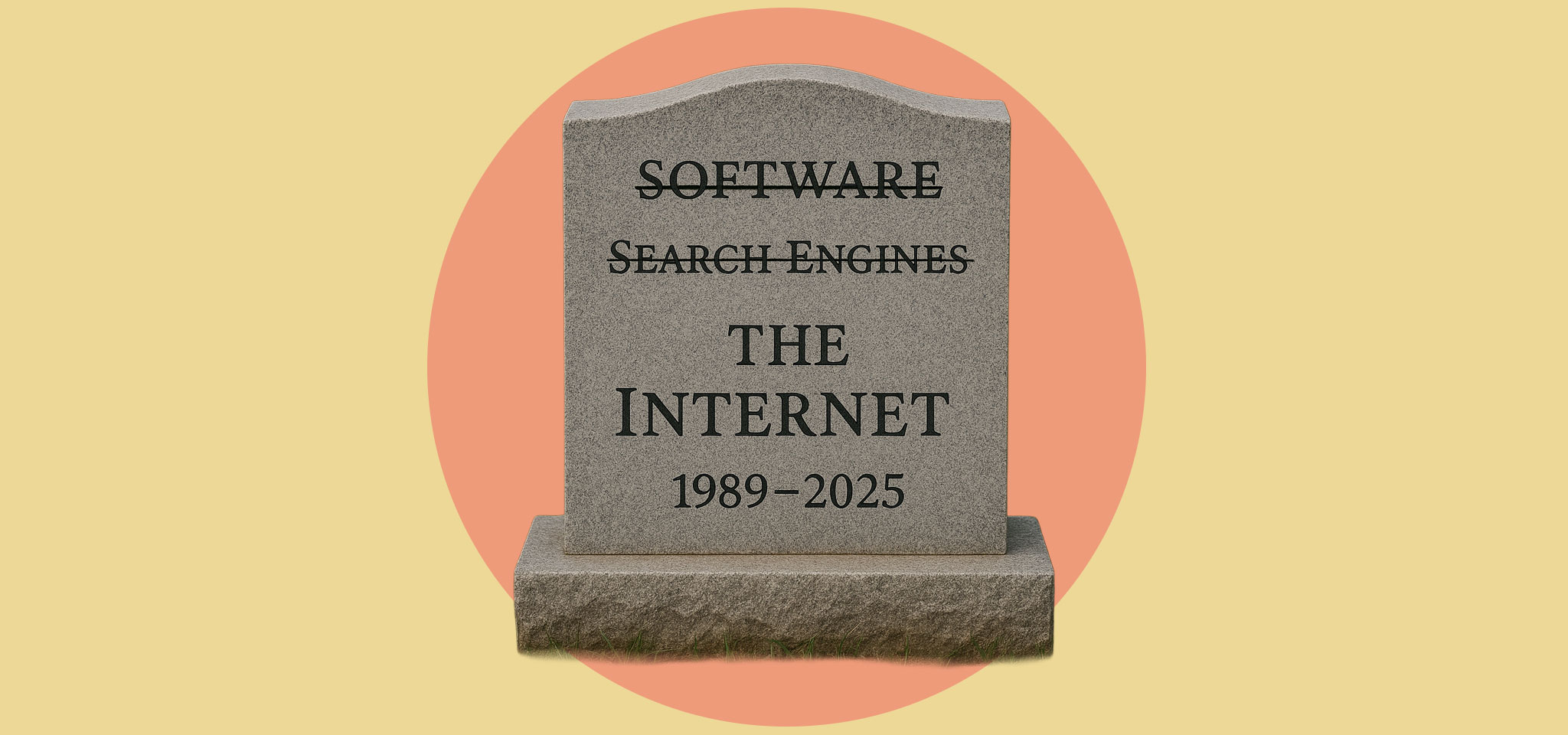
To a marketer, declaring things dead serves two purposes. First, it ends the conversation. Why are we still talking about something that's dead? Second, it opens the door for a magical new solution. Marc Benioff famously built Salesforce on the clearly preposterous claim that software is dead, which he admitted as long ago as 2008 “may have been exaggerated.” This is guerrilla marketing, not reasonable analysis.
The current premature burial in publishing seems to be that of search traffic. At several recent conferences, ‘Google Zero” is in the air. I’ve seen at least half a dozen different publishing executives, on stage, at events like Media Product Forum, ONA, The Audiencers Festival, and AMO Summit, talking about Google Zero.
As a thought exercise, “Google Zero” is a game anyone can play, but it’s a different proposition if search traffic drives 80% of your revenue or 20%.
When we’re trying to formulate a strategy, we need to examine the trends impacting both the industry and individual organizations themselves. A cursory glance at publisher traffic shows that Google search isn’t dead, of course. Perhaps it reached a local maximum and has ebbed. Perhaps indeed this local maximum is also the global maximum. This traffic loss is also a publisher-specific phenomenon. Not every publisher is losing traffic, and the publishers that are losing traffic are losing it at different rates. A death certificate removes all subtlety from complex conversations.
New Old Web is a blog published by Alley and Lede. We're researchers, strategists, designers, and developers who want to make the internet a fun place to live and work.
To be fair, much of the conversation about Google Zero is about planning, and answering the question “what happens to my business if search traffic goes to zero?” This is a valuable topic that deserves serious attention from stakeholders across the digital news business. As a thought exercise, “Google Zero” is a game anyone can play, but it’s a different proposition if search traffic drives 80% of your revenue or 20%.
An important consideration here is what value exists in declining resources. Look no further than the publishers continuing to print newspapers and delivering them to houses. I’ve heard publishers still printing papers say that they’ll stop when the print operation consistently loses money, but I know of at least one publisher who is printing more, and several startup publishers with print operations!
When Cloudflare declared that search traffic is “dying fast,” they were selling something — the idea that in order to survive the onslaught of GenAI, publishers need to charge LLMs to index their content. The solution: Cloudflare’s pay per crawl. It’s compelling, but it raises an important question beyond the basic assumption that the big LLMs will play ball — can it ever drive enough revenue to sustain publishers if Cloudflare is right that search traffic is dying? For many publishers, traffic is the top of the funnel for paid products, and if LLMs supplant entire subscription businesses, it won’t matter very much that the publisher is getting paid per crawl. In other words, if Cloudflare is wrong that search traffic is dying fast, their solution is at best marginally additive to revenue. If they’re right and it is all downhill from here, then their solution is a half-measure.
And will LLMs pay everyone? Or only the best player in each category who’s willing to play ball? I’m reminded of the concurrent race to email newsletters (“websites are dead!”). There’s a finite market for email newsletters in that humans have a limit to how many they can absorb each day. There’s probably a finite market for LLMs to pay for high-quality news. There are no magical solutions.
Marketers love declaring things dead. Marketers know what Edgar Allan Poe knew so well — people are terrified of death, but truly nothing is scarier than being buried alive. Next time you hear that something is dead, listen for bells ringing in the graveyard.